Digital twins for property and operations
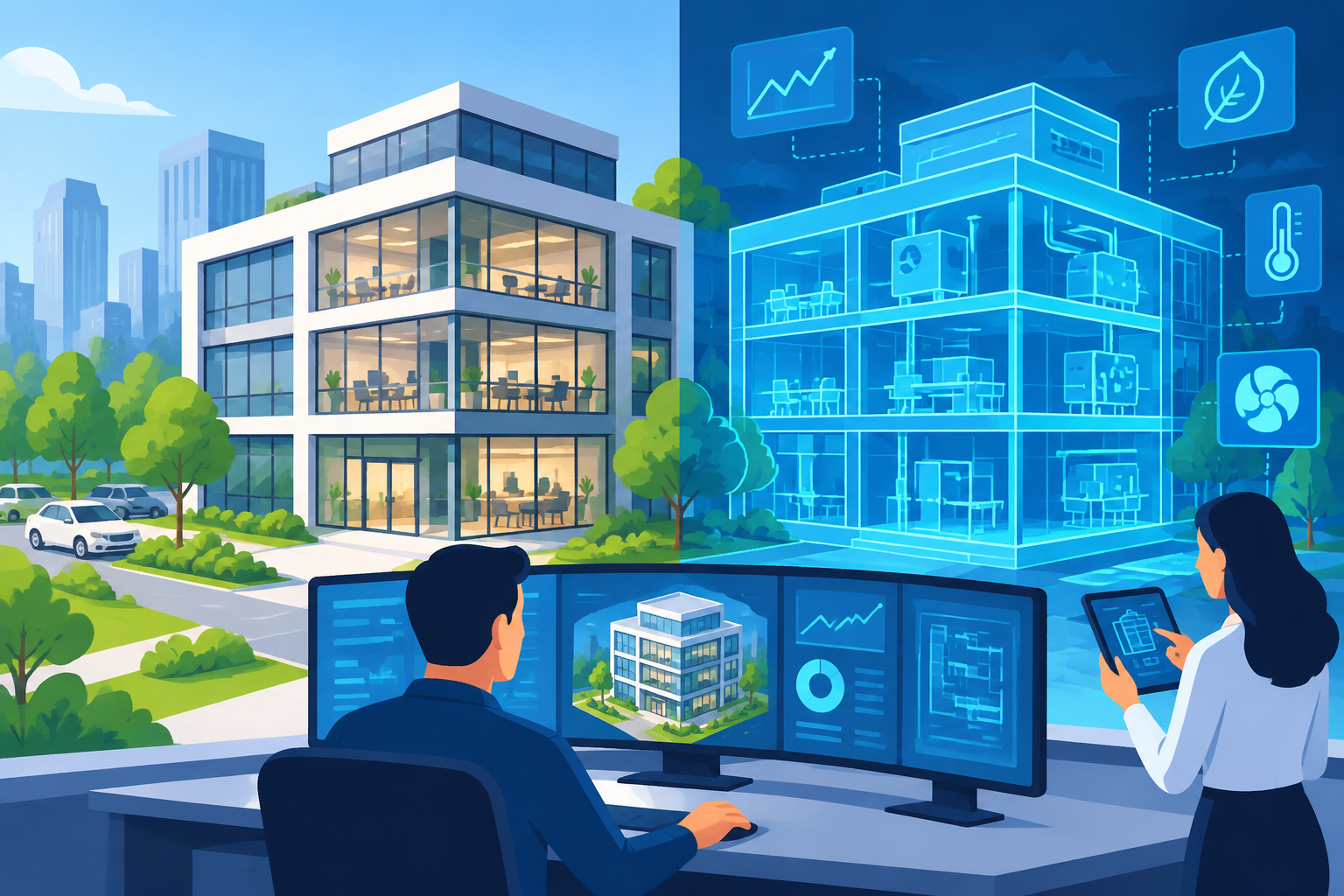
Digital twins for property and operations
By Marco Lopes · October 10, 2025 · Topic: Web Development
A building can have a detailed floor plan, a maintenance platform, access controls and thousands of sensor readings, and still be difficult to understand operationally. Those systems describe different parts of the same place, but they rarely provide a shared picture.
At Kordspace, we approach digital twins as a web development and integration challenge before we treat them as a visualisation challenge. Our goal is to connect physical assets, trustworthy data and decisions in an interface people can actually use.
For property owners, facilities teams and operators, that might mean finding an overheating air-handling unit, understanding which spaces are occupied or checking whether a repair resolved the original problem. The useful twin is the one that helps us act with confidence.
What we mean by a digital twin
We use the term digital twin for a maintained digital representation of a physical asset or environment, connected to information about its condition and operation. That representation could cover one piece of equipment, an entire building or a portfolio of sites.
A 3D model alone is not enough. Neither is a dashboard displaying disconnected measurements. The value appears when we can relate a reading to an asset, place that asset in context and connect the situation to a workflow.
We also do not assume that every twin needs constant updates or two-way control. A property inspection twin might refresh after each survey. A plant-room monitoring twin might receive readings every minute. Both can be useful if their update frequency matches the decision being made.
Before choosing technology, we define what the twin represents, how current it must be and which actions it should support.
Start with an operational question
We recommend starting with a question that a named team already needs to answer. “Can we build a digital twin?” is too broad. “Which temperature complaints relate to failing equipment rather than scheduling?” gives us something testable.
Practical starting points include:
- Linking equipment locations, maintenance history and manuals.
- Comparing energy consumption with operating schedules.
- Following leaks or environmental alerts through acknowledgement and resolution.
- Supporting remote inspections with plans, photographs and structured observations.
- Showing space availability without exposing individual movements.
We then identify the decision owner, the information required and what happens after an exception appears. If an alert has no responsible team or response process, a better interface will not solve the underlying problem.
Our first release should complete one useful loop: observe a condition, understand its context, assign an action and record the outcome.
Build the asset model before the visual layer
The hardest early work is often deciding what things are called and how they relate. A facilities system might identify a unit by an internal code, a contractor might use a label on the casing, and a building model might reference a completely different identifier.
We establish stable internal IDs and preserve mappings to source-system identifiers. We also record relationships such as building, floor, room, equipment, sensor and service area. A sensor’s physical location is not always the same as the area its equipment serves.
For each measurement, we define units, timestamps, expected frequency and quality indicators. For each asset, we distinguish observed state from configuration, maintenance records and calculated values.
We keep source provenance visible. If two systems disagree about an installation date or equipment status, silently overwriting one with the other creates false certainty. A useful twin tells us where information came from and when it was last verified.
Design a cloud architecture around clear responsibilities
For a typical web-based twin, we separate device connectivity, ingestion, storage, application services and presentation. That keeps a change in sensor hardware from forcing a redesign of the user interface.
Google Cloud is our preferred starting point. An illustrative architecture could use an edge gateway and MQTT broker for device connectivity, Pub/Sub for event distribution, Cloud Run for application services, Cloud SQL for asset and workflow records, BigQuery for historical analysis, and Cloud Storage for drawings, photographs and model files.
These are responsibilities, not a mandatory shopping list. We might need a dedicated time-series database for particular query patterns, or a simpler architecture for a small deployment. Pub/Sub is not itself a device-facing MQTT broker; that connectivity layer still needs an explicit design.
We can also work with AWS or Azure when an organisation’s existing platform, procurement requirements or operational expertise make them the better fit. We optimise for maintainability and team ownership rather than cloud branding.
Treat ingestion as a reliability problem
Physical environments are messy. Devices lose connectivity, batteries fail, clocks drift and contractors replace equipment without updating its records. We assume these failures will happen and design the data pipeline accordingly.
At the edge, we may need buffering and store-and-forward delivery. In ingestion services, we validate payloads, normalise units and handle duplicate or out-of-order events. We retain both the measurement time and the receipt time so delayed data does not masquerade as a current observation.
We also decide how to handle malformed messages and unexpected readings. Rejecting a payload should leave an auditable trail rather than make the problem disappear.
Most importantly, we distinguish “normal” from “unknown”. A disconnected temperature sensor must not remain green simply because its last reading was acceptable. Freshness and quality should travel with the data all the way to the interface.
Make the web interface useful without 3D
A spatial view can make a complex property easier to navigate, but we do not make it the only way to work. Search, lists, floor plans and asset detail pages often handle everyday tasks more efficiently than a full 3D scene.
We use progressive loading, simplified geometry and appropriate levels of detail when 3D adds value. Large models should not block access to an urgent maintenance task, especially on a phone or an unreliable site connection.
Every important state needs a clear label, not just a colour. We show timestamps, missing-data indicators and measurement units beside the relevant values. Keyboard access and readable contrast remain part of the product, even when the visual layer is sophisticated.
For remote collaboration, we favour shareable links to a specific asset, view or incident. Comments and evidence should stay attached to that context so another team member can understand the issue without reconstructing a conversation across several tools.
Connect insight to a controlled workflow
The next step after identifying a problem should be obvious. We might connect the twin to a maintenance platform, create an inspection task or attach an observation to an existing work order. Where another system owns the workflow, we integrate rather than create a competing source of truth.
We record who acknowledged an issue, what action was taken and whether subsequent observations support closing it. This turns the twin into an operational record rather than a screen that only displays the present.
Control requires a higher bar than observation. Changing a building schedule or sending an equipment command needs explicit permissions, validation, confirmation and an audit trail. Safety interlocks and local control must remain effective if the web application or cloud connection fails.
We start read-only where possible and add controlled actions only after ownership and failure behaviour are clear.
Use AI where evidence can be checked
AI can help us search equipment manuals, summarise maintenance histories, draft incident reports and explain patterns across related records. It is especially useful when the alternative is manually opening many documents to answer a narrow operational question.
We keep generated answers grounded in accessible sources. An assistant should identify the document, record or measurement supporting its response and make uncertainty explicit when evidence is missing or contradictory.
For anomaly detection, we establish a baseline and evaluate alerts against actual operating conditions. A changed occupancy schedule or sensor replacement can look unusual without indicating a fault. We provide a way for operators to classify false alarms and capture useful feedback.
We do not give a language model unrestricted control over physical systems. Recommendations and actions remain separate, with deterministic checks and appropriate human approval between them.
Secure the property, not just the dashboard
A digital twin may expose floor layouts, equipment locations, operational routines and occupancy patterns. We classify that information before deciding who can view, export or retain it.
We separate device networks from public application access and avoid exposing building controllers directly to the internet. Devices and services need scoped identities, protected credentials and a practical process for revocation or replacement.
For the application, we enforce authorisation on the server for every asset, file and action. Hiding a control in the interface is not access control. Portfolio and tenant boundaries need explicit testing.
We also minimise personal data. Where aggregate occupancy supports the use case, collecting identifiable movement histories adds risk without necessarily adding value. Retention, residency and deletion requirements belong in the architecture from the beginning.
Keep costs and ownership visible
We model operating costs around device count, sampling frequency, retention, query patterns, model delivery and user activity. A seemingly small change in measurement frequency can affect ingestion, storage and downstream processing together.
We retain high-resolution data only as long as the use case justifies it, then consider aggregation or lower-cost storage. We also budget for connector maintenance, device provisioning, model updates and support, not only cloud infrastructure.
Each data source needs an owner. Each integration needs a failure signal and a recovery procedure. We document export paths so the asset registry, observations and maintenance evidence are not trapped in an interface.
Most twins do not need blockchain. We consider Web3 components only when independently verifiable records across organisations solve a specific trust problem that simpler shared systems cannot adequately address.
Deliver a narrow pilot, then expand
We structure an initial pilot around one site, one operational question and a manageable set of assets. We audit the available data, build the identifier mappings and connect enough sources to complete the chosen workflow.
Before launch, we agree how to judge usefulness. That might include time spent locating asset information, completeness of maintenance evidence or whether operators can distinguish fresh readings from stale ones. We compare against the existing process rather than assuming that a new interface is an improvement.
We test disconnected gateways, duplicate events, missing permissions and unavailable integrations alongside normal operation. A twin earns trust by handling uncertainty well, not by looking convincing during a demonstration.
A short readiness checklist
Before we commit to a build, we check that we have:
- A defined operational question and accountable owner.
- Stable asset identifiers and accessible source data.
- Agreed update frequencies, units and freshness rules.
- A workflow for acting on findings.
- Clear access, privacy and retention requirements.
- A plan for outages, maintenance and ongoing costs.
A useful digital twin brings software, hardware and design together around real work. At Kordspace, we can help shape the first workflow, connect the right systems and build a web experience that grows with operational needs. We invite you to start a project or explore our related services.
Conversation (0)
No comments yet. Start the conversation.
Join the conversation
Create a free member account to comment.