Hardware prototype to pilot: a 90-day playbook
Hardware prototype to pilot: a 90-day playbook
By Marco Lopes · October 28, 2026 · Hardware & Gear
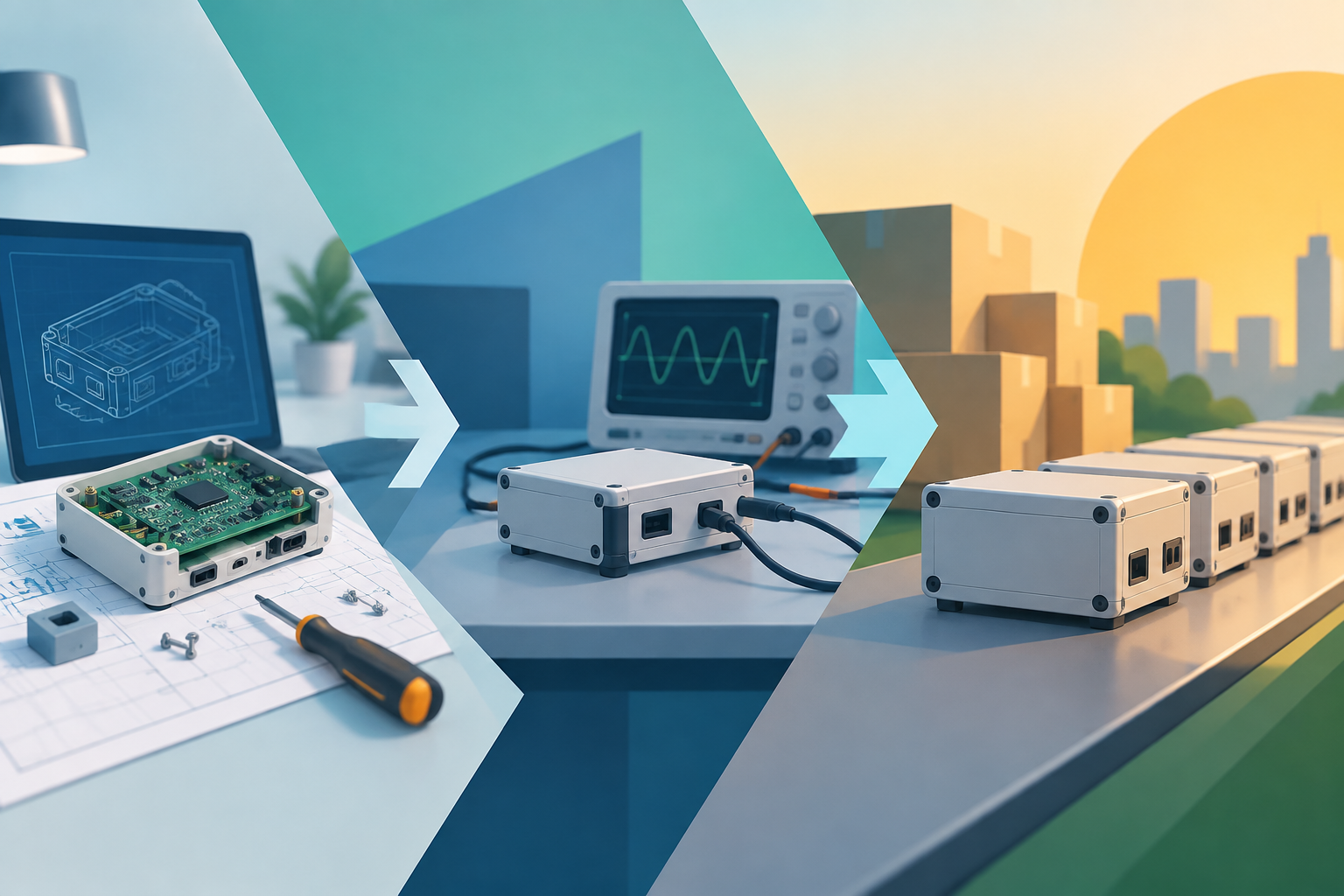
A working prototype proves that something can work. A pilot asks whether it works repeatedly, outside our workshop, with people who did not build it. Between those milestones sit the awkward details: assembly variation, unreliable networks, confusing setup, component availability, firmware recovery, and support.
At Kordspace, we approach that transition as one connected product effort. Hardware, firmware, cloud software, industrial design, and operations cannot run as separate projects that meet on launch day. As a remote collaborative studio, we make their dependencies visible from the start.
This playbook assumes we already have a functional prototype and a bounded use case. Ninety days is a planning window, not a promise that certification, custom tooling, or a regulated product can be rushed. Our goal is a controlled pilot with explicit limits, reliable evidence, and a credible next decision, not a production launch wearing a smaller label.
Define what the pilot must prove
Before we change a board or order an enclosure, we write a one-page pilot charter. We name the intended user, operating environment, core task, deployment boundary, and decision the pilot should enable.
We also define what remains outside scope. A supervised indoor trial is not evidence that a device is ready for unattended outdoor service. A successful installation by our engineers does not prove that customers can install it themselves.
Our acceptance criteria need observable outcomes: successful setup, completion of the primary workflow, recovery after power loss, and a support process that actually works. We choose thresholds based on the product’s risks and intended use, rather than borrowing generic targets.
Finally, we name the people authorized to approve deployment, stop the trial, and accept residual risk. Every later gate refers back to this charter.
Days 1–10: expose the risks before refining the design
We start with a cross-disciplinary teardown of the prototype. We inspect its schematic, PCB layout, mechanical stack, firmware, software dependencies, and cloud architecture. We also watch someone unfamiliar with it attempt the main task.
Our first deliverable is a ranked risk register. For each risk, we record the evidence we lack, the cheapest useful test, an owner, and the consequence of failure. A thermal concern deserves attention before a cosmetic refinement; a sole-source component may deserve attention before either.
We check lead times immediately. Batteries, radios, connectors, machined parts, and specialist testing can consume the schedule while software work appears to advance normally. We identify alternatives, but we do not treat a different part number as equivalent without validation.
Gate: we proceed when the pilot scope is bounded, major hazards have owners, and the procurement and testing paths look feasible. Otherwise, we reduce scope or revise the schedule.
Days 11–25: turn the prototype into a buildable system
We use this phase to stabilize interfaces rather than perfect every component. We document electrical connections, message schemas, power budgets, enclosure constraints, and expected operating states. Where teams work in parallel, those contracts prevent expensive surprises.
On the hardware side, we review protection, grounding, connector orientation, test access, mounting, and assembly tolerances. We make programming and recovery possible without destructive disassembly. We check whether the enclosure creates heat, radio, or serviceability problems that were invisible on an open bench.
We maintain a versioned bill of materials with manufacturer part numbers, approved alternatives, supplier information, and purchasing status. The assembly package includes drawings, polarity notes, torque requirements where relevant, and photographs of ambiguous steps.
We establish a change process now. Every physical revision receives an identifier, and every deviation gets recorded. A pilot becomes difficult to interpret if we cannot tell which units contain which changes.
Gate: another competent builder should be able to assemble a unit from our documentation without relying on undocumented workshop knowledge.
Days 26–40: make firmware and cloud behave as one product
A connected device needs more than a dashboard. We define provisioning, identity, authentication, telemetry, configuration, updates, and retirement as one lifecycle.
We generally prefer Google Cloud, while supporting AWS or Azure when customer infrastructure, regional requirements, or existing operations make them the better fit. On Google Cloud, a pilot might use Cloud Run for APIs, Pub/Sub for backend event routing, and an appropriate operational datastore. We still need an explicit device transport layer; backend messaging is not automatically a device connection service.
We give each device a unique identity and avoid shared fleet credentials. We define access boundaries, credential rotation, and revocation. We minimize collected data and set retention rules before telemetry begins accumulating.
Firmware must handle the ordinary failures: intermittent connectivity, duplicate messages, interrupted updates, expired credentials, and full local storage. We bound offline queues and use retries with backoff. Updates need verification, compatibility checks, and a tested recovery path.
Gate: we can provision a unit, observe its health, change its configuration safely, and recover it from a failed update under controlled conditions.
Days 41–55: test the system, not just the parts
We build a verification matrix that connects each requirement to a test and a recorded result. Passing a sensor check is useful; completing the user’s task through the enclosure, firmware, network, and interface is what matters.
Our tests include repeated power cycling, network loss, setup errors, extended operation, and plausible environmental conditions. Where applicable, we examine charging, temperature rise, ingress exposure, radio performance, and mechanical strain. We use qualified facilities and specialists when the hazard or required test exceeds our capabilities.
A pilot is not a blanket exemption from applicable safety, radio, privacy, workplace, or market-access requirements. We establish what applies to the product, location, and deployment model before field use. Pre-compliance checks help find problems early, but they do not replace required approvals.
We also run usability sessions around installation, status indicators, error recovery, and maintenance. Industrial design includes what people can understand under pressure, not only what photographs well.
Gate: critical hazards and blocking defects are resolved, required permissions are in place, and remaining limitations are documented and accepted.
Days 56–70: build a traceable pilot batch
We size the batch around the learning objective, available support, and consequences of failure. More units are not automatically better. A batch we cannot monitor or service can create noise instead of evidence.
Each unit receives a serial number linked to its hardware revision, firmware version, assembly record, and test results. We retain enough component or lot information to investigate defects without collecting irrelevant detail.
We create a repeatable end-of-line test. It covers the essential electrical checks, programming, identity provisioning, sensor or actuator behavior, connectivity, and calibration where needed. We log failures rather than repeatedly retesting until a unit happens to pass.
One reference unit stays with the team for troubleshooting. We also prepare the spare parts, replacement units, packaging, and return instructions that the support plan requires.
Gate: every deployable unit has a complete record, passes the defined tests, and can be distinguished from unapproved or quarantined hardware.
Days 71–85: deploy gradually and operate deliberately
We begin with the smallest deployment that can exercise the real workflow. Expansion follows a review of evidence, not a calendar reminder.
Installation includes a site check, account setup, connectivity validation, and confirmation that the operator understands normal behavior and warning states. We record the actual environment because field conditions often explain results better than another dashboard chart.
Our support runbook assigns responsibility for device faults, software issues, user questions, and safety escalation. We define coverage hours and escalation paths honestly. An inbox without an owner is not a support process.
We monitor signals tied to the charter: whether the core task completes, whether units remain reachable when expected, how recovery works, and what manual intervention is required. We pair telemetry with short operator conversations to understand failures that logs cannot explain.
Gate: we expand only when the initial deployment is stable enough for the intended risk level and support demand remains manageable.
Days 86–90: make the next decision from evidence
We close the pilot window with a decision memo, not a celebratory slide deck. We compare results with the original acceptance criteria and separate confirmed findings from assumptions.
Our review covers technical performance, user friction, assembly effort, component availability, cloud costs, support load, and unresolved compliance work. We include the awkward details: manual resets, engineer-assisted installations, replaced units, and missing data.
We then recommend one of three paths: proceed toward a larger deployment, repeat a narrower pilot after specific fixes, or stop and reconsider the product. Each path gets owners, dependencies, and a budget boundary.
We do not call hardware production-ready simply because a small trial went well. Manufacturing validation, supply resilience, service planning, and any remaining approvals still need their own evidence.
Keep remote collaboration concrete
Remote hardware work succeeds when physical evidence travels as reliably as code. We keep design files, decisions, test procedures, and issue tracking in agreed locations with clear versioning. Important conclusions from calls become written records.
Bench reports include the unit identifier, revision, firmware build, test conditions, and relevant photos or measurements. A video of an unexplained failure is less useful than a reproducible sequence tied to a known configuration.
We assign custody for shared equipment and prototypes, and plan shipping as a dependency. Where practical, we keep representative hardware at more than one work location. That reduces the chance that a single parcel blocks firmware, mechanical, and cloud teams together.
Keep scope and spending honest
We budget beyond the bill of materials. Engineering time, fixtures, test services, assembly, shipping, cloud usage, spare units, and field support all belong in the pilot estimate. We reserve contingency for risks we have actually identified.
AI belongs in the pilot only when it serves the core task and we can evaluate its behavior. We define a baseline, handle uncertainty, and provide a safe fallback where needed. An AI feature should not quietly become an untested dependency in a critical control path.
Similarly, we consider Web3 components only when shared verification or ownership requirements justify them. We do not add wallets, tokens, or on-chain records to compensate for an unclear product model. Complexity must earn its place.
A short pilot-readiness checklist
- We have a written charter, measurable acceptance criteria, and stop conditions.
- We can identify every unit and reproduce its configuration.
- We have tested provisioning, offline behavior, updates, and recovery.
- We have addressed applicable safety, compliance, and privacy requirements.
- We can install, monitor, support, replace, and retire pilot units.
- We know which decision the evidence will support next.
A strong pilot makes uncertainty smaller without hiding the work still ahead. We bring hardware, software, cloud, and design together so that each build teaches us something useful. If we can help move your prototype toward a controlled pilot, start a project, or explore our related services to see how we can collaborate.
Conversation (0)
No comments yet. Start the conversation.
Join the conversation
Create a free member account to comment.