Planning a 2027 product roadmap with AI in the loop
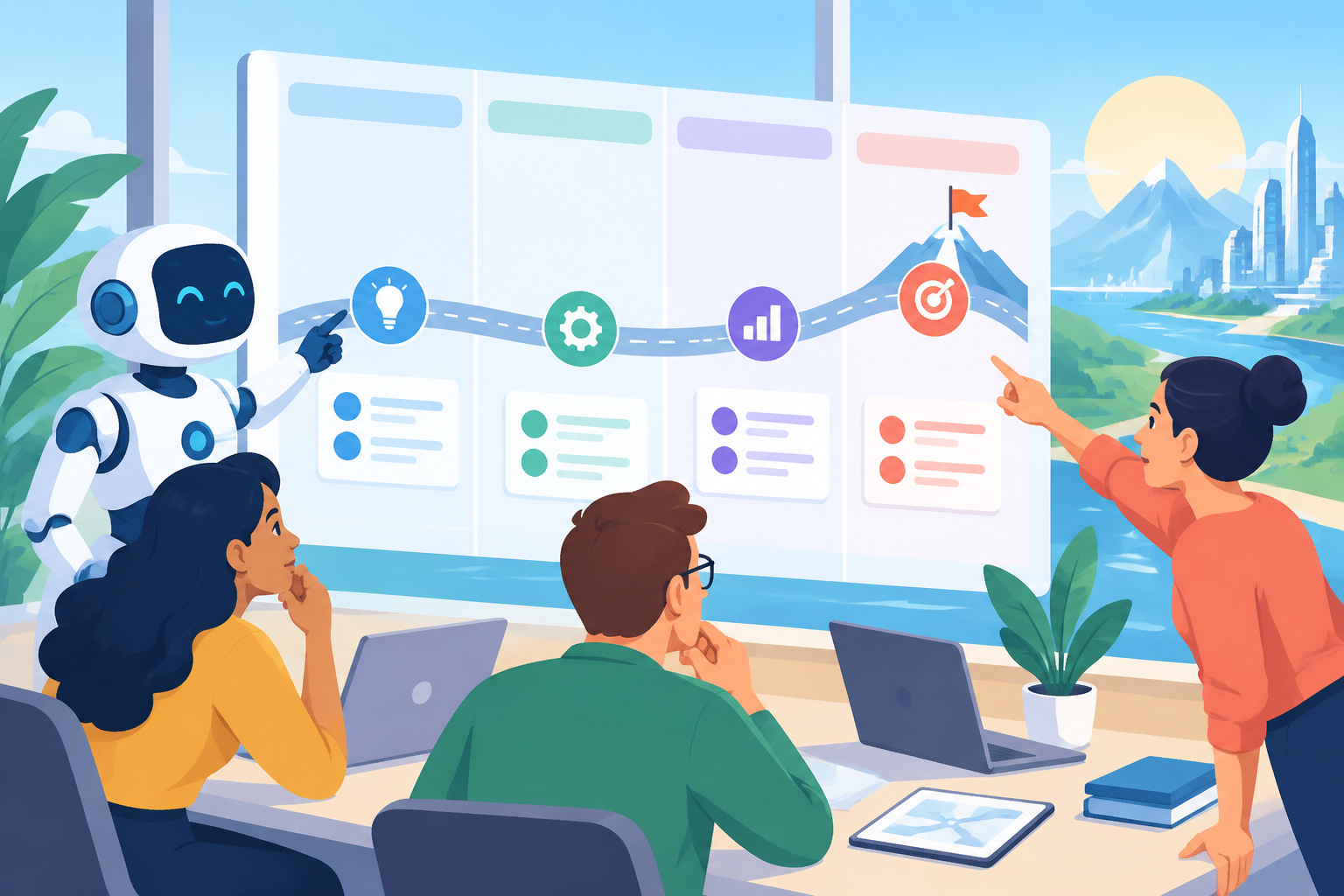
Planning a 2027 product roadmap with AI in the loop
By Marco Lopes · October 14, 2026
Topic: AI & Machine Learning
As we plan for 2027, we see a useful shift in the roadmap conversation. The question is no longer simply whether we can add AI to a product. It is where AI can improve an outcome, what evidence would justify the investment, and how we keep the resulting system understandable and controllable.
At Kordspace, we work as a remote collaborative studio across software, AI, Web3, hardware, and design. That perspective pushes us to connect strategy with delivery constraints early. A promising model demonstration is not yet a reliable product capability.
Our approach is to put AI in the loop without putting it in charge. We use it to accelerate research and explore options, while keeping people accountable for priorities, customer commitments, and release decisions. Here is how we would build a practical 2027 roadmap from that starting point.
Start with outcomes, not an AI feature list
Before we discuss models or agents, we write down the product outcomes we want to change. We might want customers to complete onboarding with less assistance, help operators resolve exceptions sooner, or make technical documentation easier to navigate.
For each outcome, we establish a baseline and name an owner. If we cannot measure the current experience, our first roadmap item may be instrumentation rather than intelligence.
We then describe the friction in plain language. “People cannot find the right installation instructions” is a more useful problem statement than “We need a chatbot.” The first leaves room for better navigation, clearer content, conventional search, retrieval-assisted answers, or a combination.
We ask three questions before giving an AI initiative space on the roadmap:
- What user task becomes meaningfully easier?
- Why might AI outperform a simpler approach?
- What happens when its output is wrong?
Those answers help us distinguish a product opportunity from a technology preference.
Use AI to support planning, not manufacture certainty
AI can help us organize research notes, group support themes, draft opportunity statements, and compare proposed initiatives. We treat those outputs as working material, not evidence by themselves.
We keep source references attached to synthesized findings. If a summary claims that onboarding is confusing, we want to trace that claim to interviews, support conversations, or observed behavior. We also check for missing perspectives: quiet customers and unsuccessful prospects may be absent from the easiest datasets to analyze.
For sensitive research, we decide what information may enter which tools before uploading anything. Redaction, access controls, retention settings, and contractual terms belong in the planning workflow, not in a later security review.
We also ask AI to challenge our preferred plan. What assumptions would make it fail? Which dependency have we hidden? The team still checks the answers, but this can make our roadmap discussion less repetitive and more rigorous.
Map workflows before choosing models
An AI opportunity becomes easier to assess when we map the whole workflow: the trigger, available information, decision points, actions, and recovery path.
Consider a hypothetical service-support assistant. Generating an answer is only one step. We also need to identify the product version, retrieve approved documentation, respect account permissions, present sources, and help the user escalate an unresolved issue.
We separate three levels of capability:
- Assist: draft, summarize, retrieve, or recommend while a person decides.
- Prepare: assemble an action for explicit review and approval.
- Execute: perform an action within defined permissions and operating limits.
We generally begin with the lowest level that delivers useful value. Moving from drafting a response to changing a customer account introduces a different risk profile, even if both experiences use the same model.
This workflow map also reveals where ordinary software remains the better tool. Authorization checks, financial calculations, and mandatory business rules should not depend on a model interpreting instructions correctly.
Prioritize by value, readiness, and reversibility
We prefer a small portfolio of testable opportunities to a long list of AI promises. For each candidate, we record expected user value, available evidence, data readiness, implementation effort, operating cost, and the consequence of failure.
We make uncertainty visible rather than hiding it inside a precise-looking score. An attractive opportunity with inaccessible data should not outrank a modest improvement we can validate quickly merely because its presentation sounds ambitious.
Reversibility matters too. A recommendation that users can ignore is easier to pilot than an automated action affecting payments or physical equipment. We ask whether we can limit exposure, roll back safely, and preserve the existing workflow.
Each shortlisted initiative gets a one-page brief containing:
- The user problem and baseline.
- The proposed intervention and simpler alternative.
- The main assumptions and dependencies.
- The evaluation plan and accountable owner.
- The conditions for expanding, revising, or stopping the work.
That brief is more useful than a feature name attached to a quarter.
Build evaluations before expanding the pilot
A convincing demonstration usually shows the happy path. Roadmap confidence requires evidence about messy inputs, missing information, and predictable failures.
We build a representative evaluation set from authorized material, with identifying information removed where appropriate. It should include routine tasks, ambiguous requests, unsupported questions, and attempts to cross permission boundaries.
We define quality for the actual workflow. For a documentation assistant, that might mean retrieving relevant sources, supporting claims with those sources, and declining to invent an answer when the documentation is insufficient. For extraction, we may need field-level correctness and a reliable review path.
We compare the AI approach with the current process and a simpler baseline. We measure latency and cost alongside quality, and use human review where automated scoring would miss important errors. If we use a model to help score outputs, we check its judgments against human assessments.
Release thresholds should be agreed before the pilot results arrive. Otherwise, we risk redefining success to fit what we have built. Passing an offline evaluation is a gate to controlled testing, not proof that the live experience is safe or useful.
Treat data and permissions as roadmap dependencies
Many AI initiatives are really data-readiness projects with an intelligent interface at the end. We need to know who owns the source material, how current it is, and whether we have permission to use it for the intended purpose.
For retrieval-based experiences, access control must apply before restricted information reaches the model. Filtering an answer after generation is not a substitute for enforcing permissions on the underlying retrieval.
We also plan how corrections, deletions, and permission changes propagate through indexes, caches, and logs. Fresh source documents are not enough if the serving system still exposes outdated copies.
Retrieved documents and external content can contain malicious instructions. We treat them as untrusted data, restrict available tools, and enforce action permissions outside the model. We give sensitive actions an explicit approval path and maintain useful audit records without unnecessarily retaining confidential content.
These requirements may not make an exciting demo, but they determine whether the feature can responsibly leave one.
Choose infrastructure for the workload
Google Cloud is our preferred starting point, but we choose architecture around the product and the organization's existing environment. We also work with AWS and Azure when their services, agreements, or operational fit make more sense.
On Google Cloud, a candidate architecture might combine Vertex AI for model capabilities, Cloud Run for application services, and BigQuery for appropriate analytical workloads. We would add storage, identity, observability, and messaging according to actual requirements rather than adopting every service available.
We keep authorization, business rules, and workflow state in application components we can test independently. We version prompts and evaluation sets alongside relevant code, and record enough deployment information to investigate regressions.
We also avoid treating provider flexibility as free. Abstraction layers have costs, and models behave differently. Where switching providers is a real requirement, we plan compatibility tests rather than assuming that matching API shapes guarantees equivalent results.
Budget for operation, not just implementation
An AI roadmap needs an operating model as well as a delivery estimate. We account for inference, retrieval, storage, monitoring, evaluation, support, and human review. Retries and long-running tool workflows can change the economics substantially.
We estimate cost per completed user task, not only per model call. A cheap call is not a bargain if users repeat it several times or staff must correct the output.
We model expected usage and heavier-use scenarios, then set budgets, alerts, and workload limits. We also plan fallbacks for unavailable services, slow responses, and exhausted allowances. Sometimes the right fallback is conventional search or a saved draft rather than another model request.
Ownership continues after launch. Someone must review failures, maintain source material, test changes, and decide when quality has deteriorated enough to pause the feature. Those responsibilities need funded capacity on the roadmap.
Sequence 2027 around evidence gates
From our October 2026 planning position, we would avoid treating every 2027 feature commitment as equally certain. A quarterly structure can still be useful if each phase has a decision gate.
Q1: establish foundations. We validate priority problems, instrument baselines, resolve critical data-access questions, and build evaluation sets. We prototype narrowly enough to test the hardest assumptions first.
Q2: run controlled pilots. We expose selected workflows to a limited audience, preserve a non-AI path, and collect evidence about task completion, errors, usability, and operating cost.
Q3: expand proven capabilities. We scale only where pilot evidence supports it. This phase includes reliability work, support processes, accessibility improvements, and integration hardening, not just additional features.
Q4: optimize and reassess. We review realized value, remove underused complexity, and prepare the next planning cycle using observed results.
This is an illustrative sequence, not a universal schedule. Hardware initiatives may need earlier procurement and safety validation. Web3 features involving signatures or assets require particularly careful transaction boundaries; an AI recommendation should not bypass authorization. Dependencies should shape the calendar.
Keep the remote team aligned
A remote roadmap needs a shared decision trail. We maintain concise initiative briefs, evaluation results, dependency maps, and decision records where the whole team can find them.
Design, engineering, product, and security should examine the same workflow early. A clear correction mechanism can matter as much as model quality, and a permissions constraint can change the interface.
We use asynchronous reviews for considered feedback and focused meetings for unresolved trade-offs. AI can summarize the discussion, but the responsible owner confirms decisions and commitments. The roadmap should show what we know, what we are testing, and what remains conditional.
A short readiness checklist
Before we commit an AI initiative to delivery, we check:
- We have a specific user problem and measurable baseline.
- We have compared AI with a simpler alternative.
- We have authorized data and enforceable access boundaries.
- We have evaluation criteria, failure handling, and release gates.
- We have budgeted operation, review, and ongoing ownership.
- We can limit exposure, reverse changes, and explain the experience.
A useful 2027 roadmap will leave room to learn without making accountability optional. We want AI to strengthen the way we plan and build, not turn uncertainty into confident-looking commitments. If you are ready to shape that roadmap with us, start a project, or explore our related services to see how Kordspace can support strategy, design, engineering, and delivery.
Conversation (0)
No comments yet. Start the conversation.
Join the conversation
Create a free member account to comment.