Real-time voice interfaces for customer apps
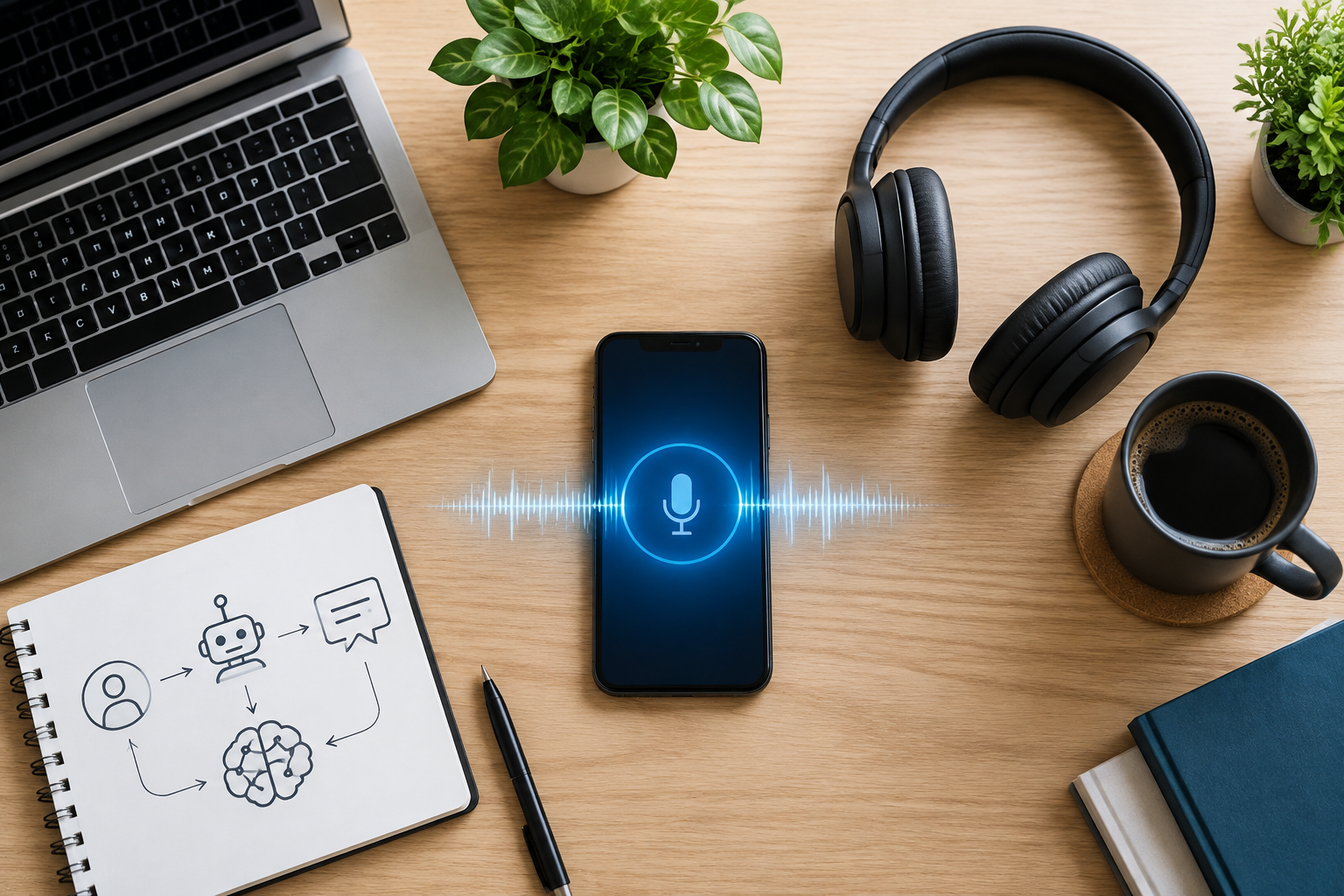
Real-time voice interfaces for customer apps
By Marco Lopes · March 14, 2026 · AI & Machine Learning
Voice becomes useful when speaking is easier than navigating. A customer describing a damaged delivery, checking an appointment while cooking, or troubleshooting a device may benefit from a conversation instead of another form. But adding a microphone button does not automatically make an app more helpful.
At Kordspace, we approach voice as a product interface connected to real systems, not a talking chatbot bolted onto a screen. As a remote collaborative software, AI, Web3, hardware, and design studio, we bring interface design and engineering into the same conversation from the start.
Here is how we approach real-time voice interfaces for customer apps, with Google Cloud as our preferred foundation and AWS or Azure where the surrounding environment makes them the better fit.
Start with a task, not a personality
We begin by identifying a narrow customer job. “Help customers manage appointments” is still broad. “Find an existing appointment, explain available alternatives, and prepare a reschedule for confirmation” gives us something we can design, test, and measure.
The first release should have a clear boundary: what the assistant knows, which actions it can perform, and when it hands over to a person or conventional interface.
We also ask whether voice belongs in that moment. Speaking payment details on a crowded train is awkward. Reading a long product comparison aloud is inefficient. A good customer app lets people move between voice, text, buttons, and human support without starting over.
Our goal is successful task completion. A convincing conversational personality is secondary.
Choose the conversation architecture deliberately
Two broad architectures are useful.
In a chained pipeline, speech recognition produces text, a language model reasons over that text, and text-to-speech generates the response. We gain inspectable intermediate outputs and independent control over each stage. The trade-off is that buffering and sequential processing can accumulate delay.
In a native audio approach, a real-time model accepts and generates audio directly. This can support more fluid interaction and preserve signals such as tone that a transcript may omit. It can also make debugging and controlling the conversation different from a text-first pipeline.
We do not assume either is universally better. A constrained support workflow may benefit from explicit transcripts and predictable speech generation. An exploratory conversational experience may benefit from native audio.
We evaluate both against the actual task, available languages, tool integration, regional availability, retention requirements, and cost, not a polished demo alone.
Separate media transport from business authority
We usually think in three layers:
- Client: microphone access, playback, accessibility, and visible conversation state.
- Conversation service: session coordination, model connection, interruptions, and context management.
- Business services: authenticated access to customer records and approved actions.
WebRTC is often a strong fit for interactive media because it provides capabilities such as jitter handling and encrypted transport. WebSockets can work well with streaming APIs, but ordering, buffering, and playback need careful attention. The model provider’s supported protocol also shapes the choice.
Long-lived credentials never belong in a browser or mobile bundle. Where supported, we use short-lived, narrowly scoped session credentials. Otherwise, we broker access through our backend.
Even when audio travels directly between the client and a provider, business actions remain behind our authorization boundary. A media connection does not grant permission to change an account.
Build a Google Cloud foundation without forcing every component into it
For a Google Cloud implementation, we can evaluate Gemini Live API capabilities available through Vertex AI, or assemble a pipeline using Speech-to-Text, a model endpoint, and Text-to-Speech. We verify supported models, regions, quotas, and data-handling terms before committing to an architecture.
Cloud Run is useful for session endpoints and tool services. We plan for connection timeouts, instance lifecycle, concurrency, and reconnects rather than treating a container instance as permanent session storage. It is not a general-purpose WebRTC media server; media infrastructure needs its own deployment decision.
Secret Manager, IAM, and Cloud Logging support credential management, access control, and operations. We keep durable business state separate from transient conversation state and place services near the chosen model endpoint where practical.
For AWS or Azure environments, we preserve these boundaries while selecting equivalent managed services. Existing identity, compliance, and operational requirements often matter more than platform preference.
Treat latency as a whole-system budget
Customers experience the pause between finishing a thought and hearing something useful. That pause can include audio buffering, end-of-turn detection, network transit, model processing, tool calls, and speech playback startup.
We instrument those stages separately. A slow database query will not become fast because we switch speech models. An overly cautious end-of-turn detector can make a quick backend feel sluggish.
Streaming helps, but only when we handle it coherently. For a text-to-speech pipeline, we send stable phrases rather than waiting for an entire answer or speaking fragments that may need revision. We also keep routine responses short.
When a tool call takes time, the assistant can acknowledge the work without claiming success. “We’re checking available appointments” is different from “Your appointment is changed.” We avoid filler that simply makes the customer wait through more audio.
Design interruptions as a normal interaction
People interrupt. They correct dates, reject suggestions, and answer before a question is finished. A voice interface that ignores this feels broken even when its underlying answer is correct.
We implement barge-in as coordinated cancellation. When genuine user speech is detected, we stop playback, cancel or disregard obsolete generation, and reconcile the conversation history with what the customer actually heard.
Microphone activity alone is not enough. Speaker echo, background television, and nearby conversations can produce false interruptions. Echo cancellation, voice activity detection, and turn-taking logic need testing on real devices.
We also distinguish “the system generated this answer” from “the customer heard this answer.” If a confirmation prompt was interrupted before the important details played, the assistant must not treat a subsequent ambiguous response as approval.
Give the model tools, not unrestricted access
A voice model should request structured actions through a small, explicit tool interface. We prefer operations such as lookup_order, list_available_slots, and prepare_reschedule over a generic tool that accepts arbitrary database queries.
Every request is validated server-side. We check the authenticated customer, resource ownership, allowed parameters, and current business state. The model’s interpretation of a spoken request is input, not authority.
For consequential actions, we separate preparation from commitment. The interface presents the proposed change and gathers an appropriate confirmation before executing it. Higher-risk workflows may require step-up authentication or an on-screen approval.
We also design for retries. If connectivity drops after a successful change, an idempotency key helps prevent the reconnecting session from repeating the action. Spoken assurances must follow verified tool results, not optimistic predictions.
Make privacy and trust visible
Microphones create a different trust relationship from text boxes. We explain when listening starts, show when it is active, and provide an obvious way to mute or end the session. Operating-system permission does not replace clear product communication.
We decide separately whether to retain raw audio, transcripts, tool events, and operational metrics. Each has a different purpose and risk profile. We minimize collection, define retention periods, restrict access, and review provider terms for the deployment we actually use.
We do not treat a familiar-sounding voice as proof of identity. Account authentication remains a separate security mechanism.
We also treat spoken instructions and retrieved content as potentially hostile. A customer or document may attempt to override system rules or expose another account’s information. Backend authorization and narrow tools must hold even when the model follows the wrong instruction.
Design the screen alongside the conversation
Most customer voice experiences benefit from a visual companion. We show recognized dates, addresses, selected products, and pending actions so people can spot misunderstandings before they become account changes.
A transcript can help, but it should not be the only interface. We include explicit controls for mute, stop, retry, text entry, and escalation. Important outcomes should remain visible after the spoken response ends.
Accessibility is part of the core design. We support customers who cannot speak, cannot hear, use assistive technology, or simply prefer not to enable a microphone. We test keyboard navigation, screen-reader announcements, and whether live updates become distracting.
Language support also needs product testing. Recognition accuracy alone does not establish that names, local address formats, or conversational conventions work well.
Test complete conversations and failure paths
We build a scenario suite before broad rollout. It includes ordinary tasks, ambiguous requests, corrections, interruptions, silence, noisy environments, expired sessions, unavailable tools, and network loss during an action.
We evaluate task completion, confirmation accuracy, unauthorized-action attempts, recovery quality, and handoff quality. Speech transcription accuracy is useful, but it cannot tell us whether the customer’s problem was solved safely.
We combine repeatable scripted tests with consent-based usability sessions. Automated evaluations help catch regressions; people reveal awkward timing, confusing prompts, and moments where speaking feels socially uncomfortable.
Observability follows the same principle. We trace session events and tool outcomes without automatically copying sensitive conversation content into logs. Where deeper debugging requires content access, we make that access controlled, purposeful, and time-limited.
Keep costs and rollout scope under control
Voice costs extend beyond a model call. We account for audio processing, generated speech, tool infrastructure, network transfer, retained data, monitoring, and human escalation. Silence and abandoned sessions can still consume resources depending on the architecture and provider billing model.
We define inactivity behavior, session limits, and context-management rules. Long conversations may require summarization, but authoritative account state stays in business systems rather than depending on a model-generated summary.
We start with a limited workflow and controlled access. A feature flag lets us disable voice without disabling the underlying customer task. We preserve a text or form-based path when the model service is unavailable.
Expansion follows evidence: reliable completion, understandable recovery, acceptable operating cost, and customer willingness to use the feature again.
A short launch checklist
Before shipping, we confirm that we have:
- A narrow task with explicit success and handoff conditions.
- Measured latency across the complete conversation path.
- Tested interruption, cancellation, and reconnect behavior.
- Server-side authorization, confirmations, and retry-safe actions.
- Clear microphone controls and documented data retention.
- Accessible text alternatives and visible action summaries.
- Monitoring, cost controls, and a working rollback path.
Real-time voice works best when it is another dependable way to use an app, not a separate world with weaker controls. At Kordspace, we bring design, AI engineering, cloud infrastructure, and product development together around that goal. To explore a voice interface for your customer app, start a project with us or read our related service pages.
Conversation (0)
No comments yet. Start the conversation.
Join the conversation
Create a free member account to comment.