Stripe and PayPal side by side: choosing billing rails
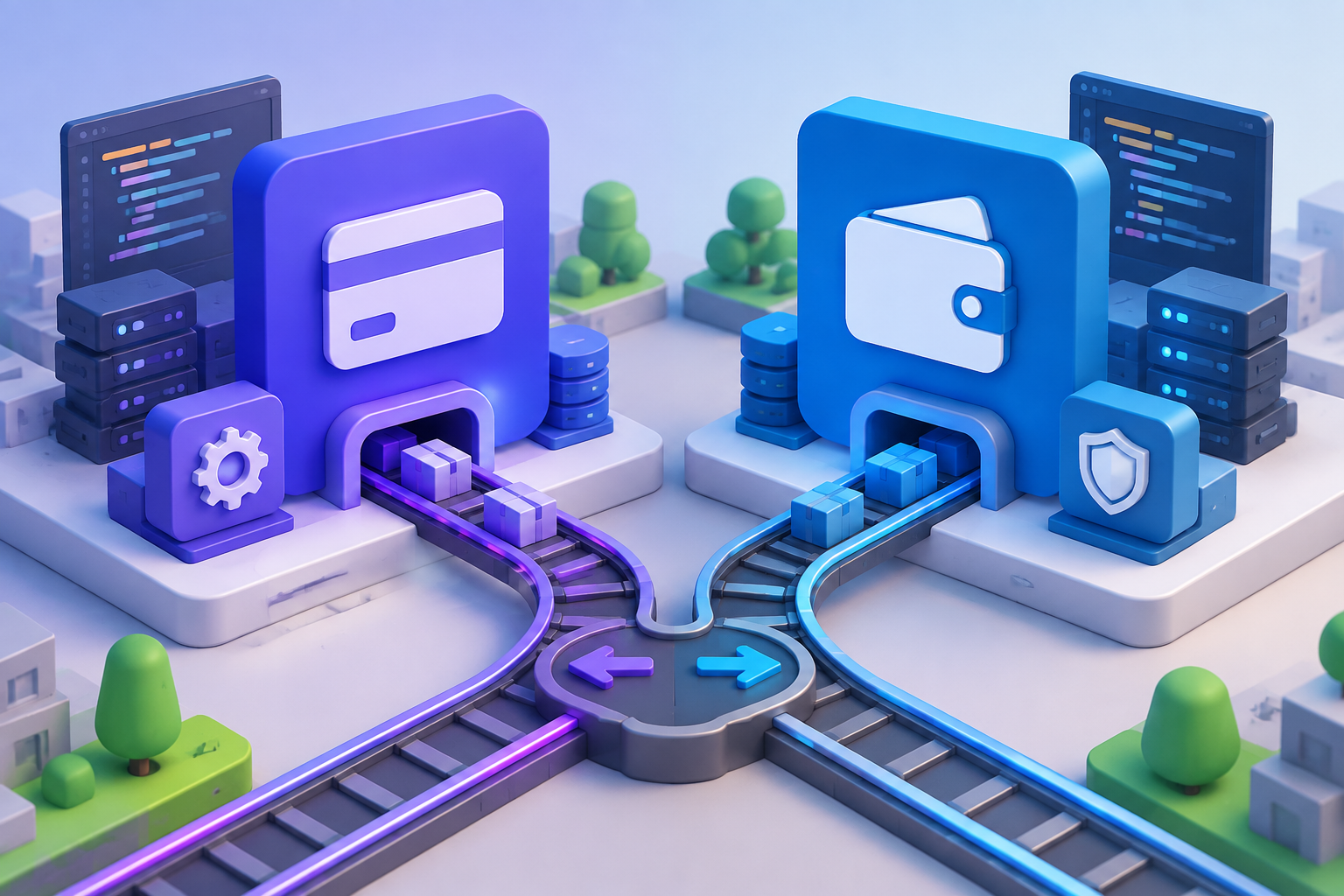
Stripe and PayPal side by side: choosing billing rails
By Marco Lopes · February 22, 2022 · Web Development
Choosing a payment provider looks simple until we map everything that happens after someone clicks “Pay.” We need to collect money, confirm orders, handle authentication, issue refunds, reconcile payouts, and support customers when something goes wrong. For recurring products, we also need to manage renewals, failed payments, and changing plans.
At Kordspace, we approach billing as part of product architecture, not a checkout widget. As a remote collaborative software, AI, Web3, hardware, and design studio, we work across products with very different commercial requirements. A software subscription and a physical device preorder should not inherit the same billing assumptions.
Stripe and PayPal are both credible choices. Our recommendation depends on the buying journey, operating model, and engineering capacity, not a universal winner.
Start with the transaction, not the brand
Before comparing dashboards, we write down what we are selling, who is buying, and when money should move.
For a straightforward digital purchase, immediate payment and fulfillment may be enough. For hardware, we may need authorization followed by capture when an order ships. For a subscription, we need a durable relationship between the customer, their agreement, and their access to the product.
We also identify seller location, customer markets, currencies, expected payment methods, and refund policies. Neither provider offers every capability in every country or for every business category.
Our first deliverable is a payment flow diagram. It should include cancellation, failure, refund, and dispute paths alongside the successful purchase. Those branches often reveal more than a feature comparison does.
Stripe: a strong foundation for custom billing
We tend to consider Stripe early when billing is closely connected to application behavior. Its APIs cover payments, customers, subscriptions, invoices, and related workflows within a consistent developer model.
Stripe Checkout gives us a hosted checkout experience with less interface work. Stripe Elements gives us more control over the payment form while keeping sensitive payment fields within Stripe-provided components. We choose between them based on genuine product requirements rather than assuming custom checkout is automatically better.
For recurring products, Stripe Billing supports subscription management and invoicing. The hosted customer portal can also reduce the amount of account-management interface we need to build.
The trade-off is responsibility. Flexible APIs still require careful state management, webhook handling, and support tooling. Stripe does not remove the need to design a billing system; it gives us useful building blocks.
PayPal: a familiar way for customers to pay
We consider PayPal when customers may prefer paying through an existing PayPal account rather than entering card details into another checkout. That familiarity can be valuable, but we treat its effect on purchasing behavior as something to measure, not assume.
PayPal Checkout integrates through its JavaScript SDK and server-side APIs. Depending on eligibility, market, and integration, the checkout can present different funding options. We verify the actual experience for our intended buyers rather than designing around a button shown in a generic demonstration.
PayPal also supports subscriptions, so it is not limited to one-time purchases. We examine its plan model and subscription lifecycle against the product’s requirements before committing.
Guest card checkout and other options are not identical everywhere. We avoid promising that every buyer will see the same payment choices.
Compare the workflows side by side
Our comparison starts with the work each provider lets us avoid, and the work it leaves with our team.
| Decision area | Stripe | PayPal | | --- | --- | --- | | Checkout | Hosted Checkout or a more customized Elements integration | PayPal Checkout with funding options subject to eligibility | | Recurring billing | Billing APIs, invoices, and a hosted customer portal | Subscription APIs and plan-based recurring payments | | Customer experience | Card and supported local payment methods within the chosen integration | A recognizable PayPal approval flow and eligible alternatives | | Engineering focus | Application-level payment and billing orchestration | Order approval, capture, and subscription lifecycle integration | | Operational review | Refunds, disputes, payouts, and reconciliation | Refunds, disputes, payouts, and reconciliation |
We do not treat these columns as exclusive capabilities. Both providers have broader product portfolios. We compare the specific products available to our business as of this publication date, not their brands in the abstract.
One provider or both?
Offering Stripe and PayPal together can make sense when we want a primary card-payment flow plus PayPal as an alternative. It does not mean running every transaction through both systems.
For one-time purchases, we can create an internal order and associate it with whichever provider the customer selects. We keep fulfillment provider-independent, so a successful payment triggers the same business process regardless of the checkout route.
Subscriptions make a dual-provider setup more demanding. We must manage two sets of subscription identifiers, cancellation behavior, payment failures, and support procedures. Moving an existing subscription between providers is not simply changing a field in our database; it may require customer participation and a new payment agreement.
For an early product, we often favor one well-integrated provider unless customer requirements justify the second. Additional choice should earn its operational cost.
Model billing separately from product access
We avoid making a provider’s status field the application’s entire source of truth. Instead, we maintain our own records for orders, subscriptions, payments, refunds, and entitlements, linked to external identifiers.
A payment and an entitlement are related, but they are not identical. A subscription can enter a failed-payment recovery period while access remains temporarily available. A hardware order can be paid but not yet shipped. A partial refund may not cancel the whole purchase.
We define these rules explicitly. Which event grants access? When do we suspend it? What happens after a dispute or an out-of-band refund?
This internal model also makes support easier. We can explain what happened without requiring every teammate to interpret provider-specific objects.
Treat webhooks as essential infrastructure
A browser returning to a success page is not reliable proof that we should fulfill an order. The customer may close the tab, lose connectivity, or revisit a URL. We use server-side verification and authenticated provider events to establish payment state.
Our webhook handlers verify signatures, record the incoming event, and acknowledge receipt promptly after durable acceptance. We then process business actions through a queue where appropriate.
We assume events can be duplicated, delayed, or delivered out of order. Processing must be idempotent: receiving the same payment notification twice must not ship two devices or grant duplicate credits. When necessary, we retrieve the latest object from the provider before applying a transition.
For outbound requests, we use provider-supported idempotency mechanisms where available. We also maintain internal uniqueness constraints and recovery paths rather than relying on network calls to succeed exactly once.
Understand fees beyond the headline rate
We compare pricing using the transactions our product actually expects. Domestic card payments, international purchases, currency conversion, disputes, and additional billing services can have different costs.
We check the provider’s published pricing for the business’s country and the relevant product. We also review refund treatment, payout arrangements, and any negotiated terms. A generic percentage copied from another market is not a useful budget.
Engineering and operations belong in the calculation. A lower processing charge can be outweighed by custom maintenance, difficult reconciliation, or additional support work. Conversely, a polished integration may still be unnecessarily expensive for a simple use case.
Our aim is a transparent cost model, with assumptions documented so we can revisit them as the product changes.
Keep security and compliance boundaries clear
We generally prefer provider-hosted checkout or provider-controlled payment fields over handling raw card details ourselves. These approaches can reduce PCI compliance scope, but they do not make compliance obligations disappear.
We keep secret keys on the server, restrict access by role, and separate test credentials from production credentials. We never place secrets in frontend bundles or log complete payment payloads without reviewing their contents.
For card payments in markets affected by Strong Customer Authentication, we use integrations designed to support the necessary authentication flows. We test the extra steps instead of treating them as unusual edge cases.
We also distinguish payment processing from merchant-of-record services. Choosing a gateway or processor does not automatically transfer our responsibilities for tax, consumer rights, or lawful sales. We confirm those obligations separately.
Subscriptions need a policy, not just an API
Before implementing recurring billing, we define trials, upgrades, downgrades, proration, cancellation timing, and payment-failure recovery. Otherwise, the provider’s defaults can become accidental product policy.
We make the customer-facing language match the actual behavior. If cancellation takes effect at the end of a billing period, the account screen should say so. If changing plans creates an immediate charge, we show that before confirmation.
We also plan for invoices, tax information, and billing-contact changes. Stripe Tax is an option worth evaluating for supported tax-calculation needs, but we verify coverage and the remaining registration, filing, and remittance responsibilities.
With either provider, we test renewals and failures alongside signup. The first successful payment is only the beginning of a subscription relationship.
Deploy for recovery and visibility
Google Cloud is our preferred infrastructure environment, though the same architecture can run on AWS or Azure. A practical Google Cloud setup can use Cloud Run for payment endpoints, Secret Manager for credentials, Cloud Tasks for deferred work, and Cloud SQL for transactional billing records.
We keep the design proportional to the product. A small application does not need a separate service for every billing action, but it does need durable records, controlled retries, and observable failures.
We monitor webhook failures, stuck orders, and discrepancies between internal records and provider transactions. Logs should connect an internal order to external payment identifiers without exposing sensitive information.
We also create a reconciliation process. Webhooks support timely updates; periodic checks help us discover missed events and operational mistakes. Neither replaces the other.
Our short launch checklist
Before we enable live payments, we check that we have:
- Confirmed country, currency, business-category, and payment-method eligibility.
- Tested success, authentication, decline, cancellation, and retry flows.
- Verified webhook signatures and duplicate-event handling.
- Defined fulfillment, access, refund, and cancellation rules.
- Reviewed fees, tax responsibilities, and customer-facing terms.
- Separated production secrets and limited dashboard access.
- Prepared reconciliation, monitoring, and support procedures.
We then run a controlled live transaction and refund, where permitted, to validate the production path. Sandbox testing is necessary, but it cannot verify every account setting or operational detail.
Choose the rails that fit the product
We lean toward Stripe when application-level billing flexibility is the main requirement. We consider PayPal when its checkout experience matches customer preferences, and we combine them when that additional choice justifies maintaining two integrations. In every case, reliable payment architecture matters more than the logo on the button.
At Kordspace, we connect payment decisions with product design, software architecture, and day-to-day operations. If we can help shape a checkout or subscription system for your product, start a project, or explore our related services pages to see how we work.
Conversation (0)
No comments yet. Start the conversation.
Join the conversation
Create a free member account to comment.