You Can Tokenize the Stock, But You Can't Tokenize Permission.
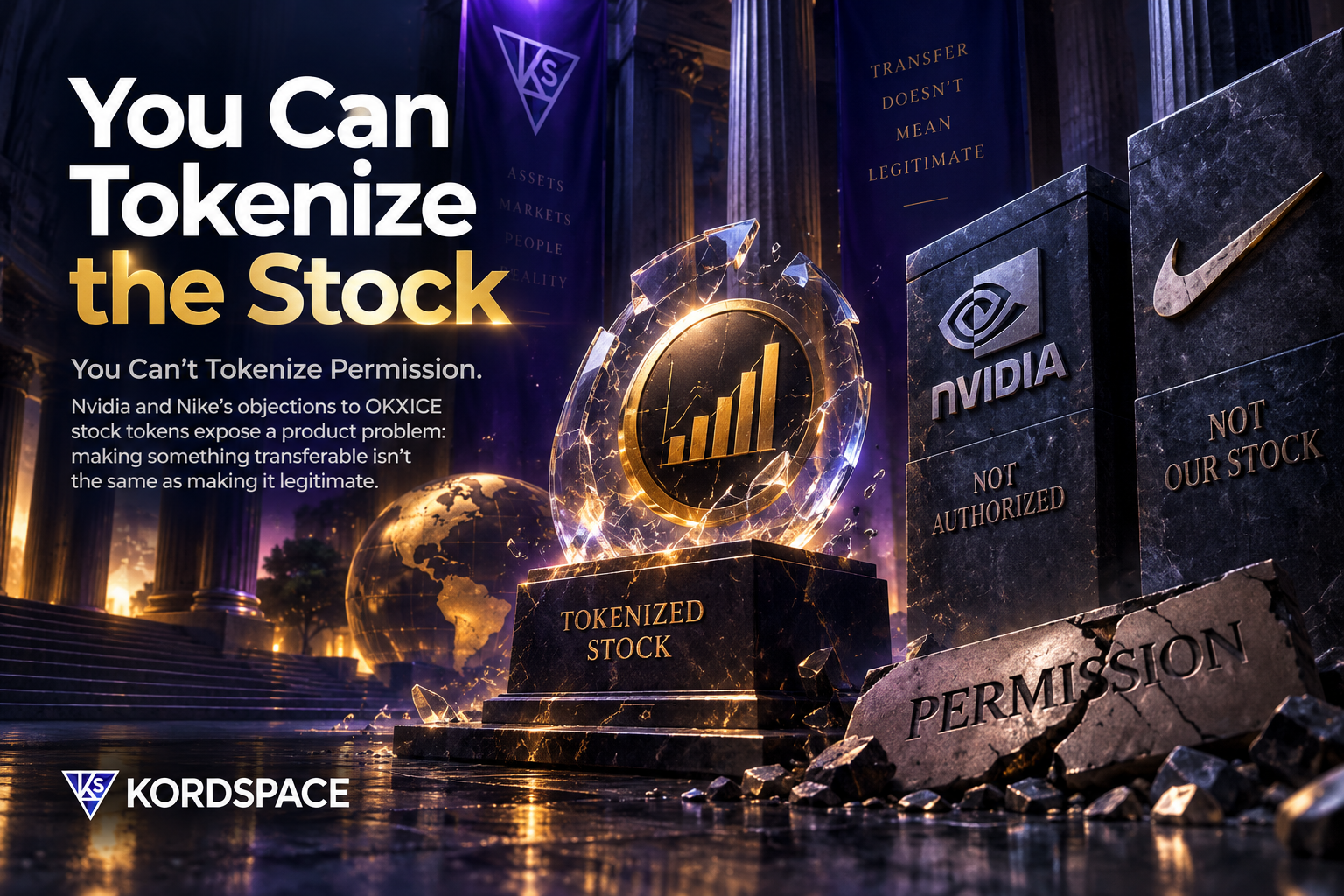
Making something transferable isn't the same as having permission to build a market around it.
I think one of the more useful questions you can ask about a technology product is also one of the least exciting: who gets to say no?
Not whether the code compiles. Not whether the wallet connects. Whether somebody outside your engineering team can look at the entire arrangement and decide it isn't happening.
That question sits underneath Daily Crypto Briefs’ November 2, 2026 report that 50 issuers, including Nvidia and Nike, have objected to third-party stock tokens trading on OKXICE. The report says the notices do not explain the companies’ individual reasons. So let's avoid inventing a dramatic ideological battle between corporate America and blockchain. Source (dailycryptobriefs.com)
The more interesting story, to me, is about product design.
You can build the mechanism for moving something before you've settled the conditions under which anyone should be able to move it.
Very impressive engineering. Slightly awkward business model.
The objection isn't a bug in the smart contract.
The SEC’s September 17, 2026 exemption requires a venue to notify the underlying issuer before offering stock tokens created by an unaffiliated third party. Trading must wait at least 30 calendar days after receipt. A timely written objection prevents that venue from making those tokens available under the exemption. Source (sec.gov)
That distinction matters. Nasdaq’s issuer FAQ explains that objections apply to the particular venue, not every possible tokenized-securities venue. This isn't a universal blockchain veto. Source (nasdaq.com)
Nor would I treat the absence of an objection as enthusiastic endorsement. A process that permits proceeding without an objection isn't the same thing as a partnership announcement.
For builders, my takeaway is straightforward: permission belongs in the product model, not in a folder somebody promises to review before launch.
If an external decision determines whether a feature can exist, that decision is a dependency. Treat it with at least as much seriousness as the database connection.
A token isn't an explanation of what you own.
To be fair, OKXICE’s October 30 notice doesn't simply wave away the underlying arrangements. It describes third-party tokens backed one-for-one by shares held through a registered broker-dealer, representing a security entitlement to one share. It also specifies checks covering equivalent holder rights, reserve documentation, dividends, voting and corporate actions. Source (okx.com)
Those provisions deserve attention precisely because they are less photogenic than a trading interface.
The question I would ask isn't whether the token looks like a share in somebody's wallet. It's whether a customer can understand the chain of responsibilities behind it.
Who holds the underlying asset? Who handles a distribution? Who corrects a discrepancy? What happens when the customer wants out?
I wouldn't accept “it's on-chain” as an answer to any of those questions. That tells me something about the record. It doesn't, by itself, explain the service.
The token is the interface. The rights are the product.
Permission should survive contact with the architecture.
There's another useful detail in the venue’s notice. Its proposed architecture uses permissioned Uniswap v4 pools on XLayer, with access controlled through nontransferable wallet credentials following screening. The operator also retains administrative powers, including pausing pools and changing wallet permissions. Source (okx.com)
I don't consider that an automatic indictment. I'd rather see control described honestly than hidden behind a decentralization slogan.
But I would want the interface to reflect those controls. Don't present unrestricted freedom on the purchase screen and introduce the restrictions only when somebody needs support.
From a Kordspace builder's perspective, this is where the interesting work starts: making the technical state, the operational state and the customer promise agree.
A working transfer function is only one part of that agreement.
What I would actually build first.
Before commissioning the trading animation, I'd ask the team for a rights-and-responsibilities map.
For every customer action, identify the responsible organization, the required permission, the evidence supporting it and the failure response. Have qualified counsel validate the legal interpretation; have engineers turn the resulting requirements into explicit system behavior.
Then make eligibility a proper lifecycle. Proposed, awaiting notice completion, eligible, blocked and suspended should not collapse into a single checkbox called “active.” Require evidence for transitions and keep an auditable history.
Next, test the unpleasant paths. A backing discrepancy. An unavailable redemption service. A corporate action that needs manual intervention. A wallet that loses eligibility.
These are proposed test scenarios, not allegations about this venue. I'd want them exercised before calling any comparable product ready.
Finally, test the explanation. Ask someone unfamiliar with the architecture to describe what they hold, who owes them what and how they leave. If they can't, rewrite the screen before buying more traffic.
That's the Kordspace angle here: build the responsibility model alongside the data model. Neither should be an appendix to the other.
I'm interested in tokenization when it makes a useful arrangement easier to operate. I'm less interested when the arrangement remains unclear but the transfer button gets faster.
Build the permission model before polishing the buy button.
Conversation (0)
No comments yet. Start the conversation.
Join the conversation
Create a free member account to comment.