Your Robot Can Work a Full Shift. That Doesn't Mean It Pays for Itself.
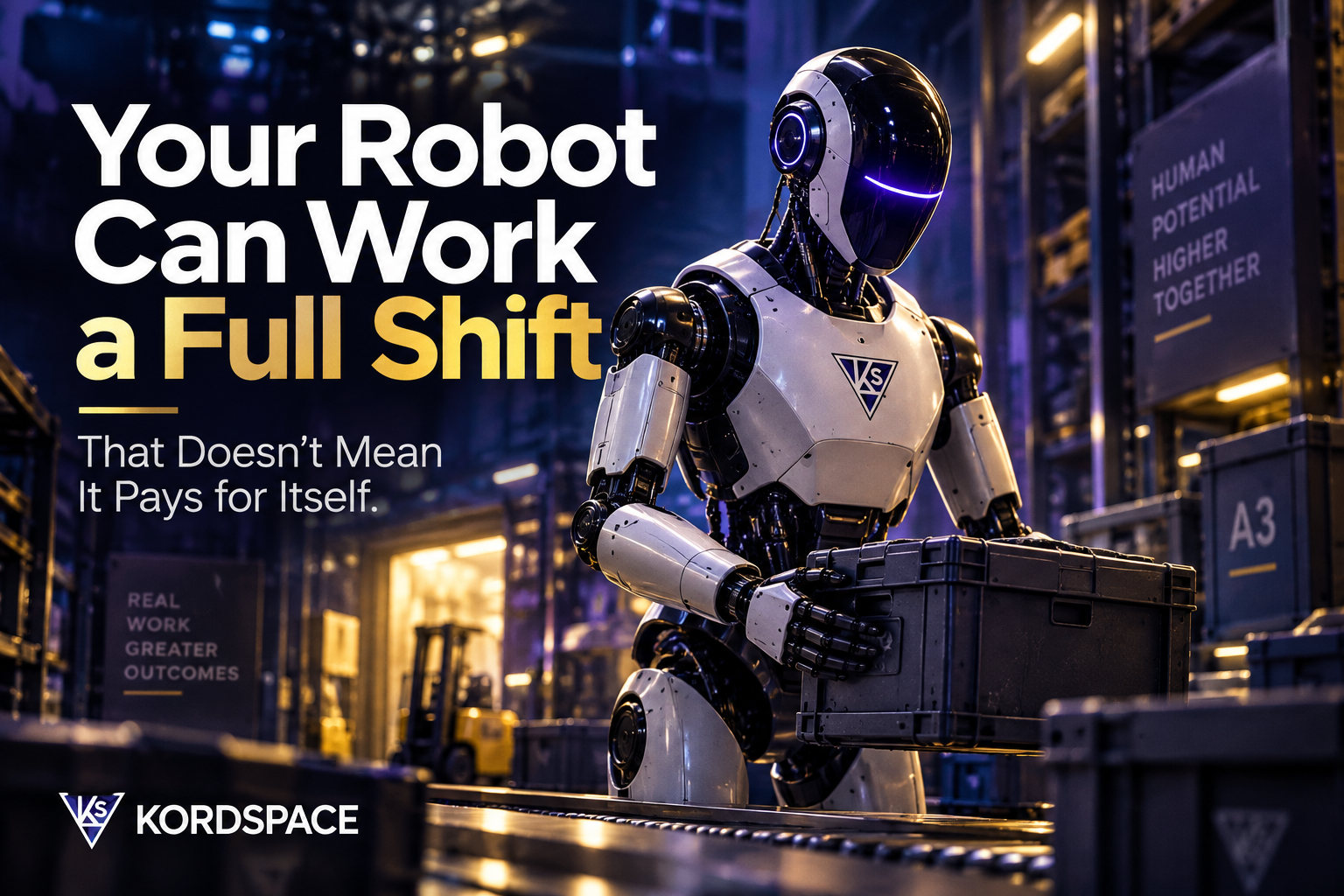
Your Robot Can Work a Full Shift. That Doesn't Mean It Pays for Itself.
Watching a robot move a box is impressive. Working out whether you should pay it to move that box is a different project.
I’m interested in humanoid robots. I’m considerably less interested in approving a purchase because something with knees successfully completed a shift.
That might sound unnecessarily cynical about a genuinely difficult engineering achievement. It isn’t meant to be. Getting a machine to perform useful physical work deserves recognition. But I think we should be careful about allowing admiration for the engineering to stand in for an explanation of the business.
The November 3, 2026 PYMNTS story gets at that distinction through AGIBOT’s proposed Worken metric: active robots multiplied by autonomous working hours and an output efficiency ratio against a task benchmark. It measures productive work rather than simply counting machines. That seems like a sensible improvement. (pymnts.com)
It still leaves me with a fairly ordinary question.
What did all that work cost?
A better productivity score is still not a business case.
As PYMNTS points out, Worken has no cost term. Equipment, integration, maintenance and other expenses sit outside the calculation. It is also a manufacturer’s proposed framework, not an established industry standard. (pymnts.com)
I don’t think that makes it useless. I think it makes it a productivity metric, which is a perfectly respectable thing to be without also pretending to be an investment committee.
Figure’s own account of its BMW deployment provides useful operational detail: more than 90,000 parts loaded and more than 1,250 hours of runtime during an 11-month deployment. Those are reported results from the manufacturer, not an independently established payback calculation. (figure.ai)
Figure also identifies cycle time, placement accuracy and human interventions as its three critical performance indicators. That is the kind of detail I want to see, because it makes the work more understandable than a video of a robot looking industrious. (figure.ai)
But I would still ask a buyer to build a separate economic case.
A robot doing useful work is an engineering achievement. A robot paying for itself is a business result.
Those achievements can overlap. We should not assume they are interchangeable.
The product is the workflow, not the robot.
Agility’s June 2024 GXO announcement offers a useful illustration. Digit’s job included moving totes from other robots onto conveyors, with Agility Arc orchestrating the work and integrating the deployment with existing automation. The arrangement was offered through a Robots-as-a-Service agreement. (agilityrobotics.com)
The part I find interesting is everything surrounding the humanoid.
From a Kordspace builder’s perspective, I would treat that entire handoff as the product boundary. Not the arm movement. Not the successful pickup. The complete journey from a task being requested to the receiving system confirming that the work is accepted.
Imagine a robot placing a container exactly where it belongs, while the warehouse software fails to record the transfer. For this hypothetical deployment, I would count that as an unresolved transaction, not a successful business outcome with an unfortunate software footnote.
Someone still needs to reconcile it.
I would want the same scrutiny applied to retries, rejected work and human assistance. Otherwise, we risk designing a beautiful automation report around a person quietly fixing everything just outside the camera frame.
That person should at least get a chair.
Before buying more robots, instrument one complete job.
My approach would be deliberately unglamorous.
Start with one bounded workflow. Define what an accepted result looks like, including quality and completion time. Measure the existing process under comparable conditions before deciding what the robot has improved.
Then connect each robot task to the business record it is supposed to change. Give it a traceable identifier. Record the request, attempts, acceptance, exceptions and any human recovery work.
I would want three views of the same pilot.
The engineering view: Can the system complete the task reliably?
The operations view: Does the complete workflow improve, including the work handed to other people?
The business view: What benefit is actually realized after deployment and running costs?
Keep released capacity separate from cash savings. If a pilot frees someone’s time, record what that time is used for rather than immediately describing it as a smaller payroll.
Likewise, if the purpose is reducing unpleasant work or developing future capability, say so. Those can be legitimate reasons to experiment. They should have their own acceptance criteria rather than borrowing an imaginary financial return.
Before expanding, agree on the evidence that would justify continuing, changing direction or stopping.
Preferably before everyone becomes emotionally attached to the robot.
Make the humanoid compete with the boring option.
I would also insist on comparing the deployment with a simpler alternative: a changed layout, a different fixture, conventional automation or removing an unnecessary transfer altogether.
Not because those options must win. Because the purchasing decision should be about the job, not a commitment to giving the solution elbows.
Humanoid robotics deserves serious experimentation. My argument is that serious experimentation should include the possibility that the machine works and the purchase still doesn’t make sense.
At Kordspace, that is the standard we should bring to hardware, AI and the software connecting them: define the outcome, expose the surrounding work and make the benefit testable.
Let the robot demonstrate the future. Make the pilot justify the invoice.
Conversation (0)
No comments yet. Start the conversation.
Join the conversation
Create a free member account to comment.